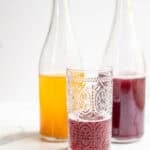
Water Kefir
Lightly sweetened and refreshingly effervescent, water kefir offers gut-healthy probiotics and delicious hydration. Learn how to make water kefir in your own kitchen with this simple tutorial.
Servings: 28 ounces
Equipment
- 1 Half-gallon jar I like to have the extra space in a half-gallon jar, as a quart-sized jar would be filled to the brim.
- Flip-top bottles (optional) I like these Grolsch flip-tops for a second fermentation to create a bubbly water kefir soda. You can use any glass bottle with a tight, secure-fitting cap, though some lids are more prone to exploding from the pressure or leaking air and yielding a flat kefir.
Ingredients
- 1/4 cup organic unrefined sugar
- 1/2 cup hot water
- 3 1/2 cups cold water
- 1/4 cup water kefir grains plump and hydrated
- Juice optional – Used to make water kefir soda with a second fermentation.
Instructions
- Add 1/4 cup of organic, unrefined sugar to a half-gallon jar. In a saucepan, bring 1/2 cup of water to a boil. Slowly add the hot water to the jar of sugar and stir until dissolved.
- Add the remaining cold water, stir well, and ensure the solution is cool or room temperature, but not hot. Add 1/4 cup of kefir grains to the half-gallon jar.
- First fermentation. Place a loose lid on top, or cover with a towel or coffee filter secured with a rubber band so the kefir can breathe. Allow to ferment for 24 to 48 hours at room temperature.
- After the first fermentation, use a small, fine-mesh strainer to strain the kefir grains from the fermented liquid. Place the kefir grains in a new batch of sugar water to start the next batch of kefir, or refrigerate them in sugar water to pause the process (instructions above, included in Water Kefir Grains Care). After this first fermentation, you have created plain water kefir. Store in the refrigerator with an airtight lid.
Second Fermentation (Optional)
- Second fermentation. Acquire some flip-top bottles with a 14 to 16-ounce capacity. Your bottles do not have to be flip-top, but should have secure, tight-fitting lids.
- Add 1/4 cup of fruit juice or mashed/chopped fresh or dried fruit to each bottle.
- Distribute the strained water kefir evenly into each bottle using a metal or plastic funnel. Close the flip-top lids and leave them at room temperature out of direct sunlight for 24-48 hours.
- Open the bottles slowly to listen for hissing or a "pop" which indicates building pressure. Water kefir can sometimes be quite explosive. If there is hardly a “pop” sound at all when opening the lid, your soda probably isn’t fermented enough. When this happens to me, I simply close the cap and set it back out on the counter for another day. I like mine to be really bubbly!
Video
Notes
Use a 1:16 ratio of kefir grains to water, and a 1:1 ratio of sugar to grains. For instance, I used 1/4 cup of grains for 4 cups of water (1 part kefir grains to 16 parts water) and 1/4 cup of sugar to the 1/4 cup of grains (1:1). If you have 3 tablespoons of grains, use 3 cups of water and 3 tablespoons of sugar in your solution.
Kefir grains multiply rapidly. Keep what you need in your jar for your next batch. Extras can be fed to your chickens, composted, blended into smoothies for added probiotics, or sold or given away.
Make sure the sugar water is completely cooled before adding the water kefir grains, because hot temperatures can kill the beneficial bacteria.
Use a silicone, stainless steel, or wooden spoon to stir or transfer kefir grains. Too much exposure to certain reactive metal utensils can damage kefir grains.
If using low-sugar fruits in the second fermentation, you may need to add 1 teaspoon of organic sugar per 16 ounces to the solution to ensure proper fermentation.
Do not use artificial sweeteners like stevia or monk fruit to ferment water kefir. They do not have the necessary bacteria or yeasts.
Use filtered water. Chlorine in city tap water can damage kefir grains. Distilled water will not contain the minerals needed for a robust fermentation.
Overfermenting may result in an overly sour flavor.
Nutrition
Serving: 8ounces | Calories: 10kcal | Carbohydrates: 2g | Protein: 0.02g | Fat: 0.01g | Saturated Fat: 0.001g | Polyunsaturated Fat: 0.001g | Sodium: 2mg | Potassium: 5mg | Fiber: 0.01g | Sugar: 2g | Vitamin A: 0.4IU | Vitamin C: 0.005mg | Calcium: 2mg | Iron: 0.01mg