
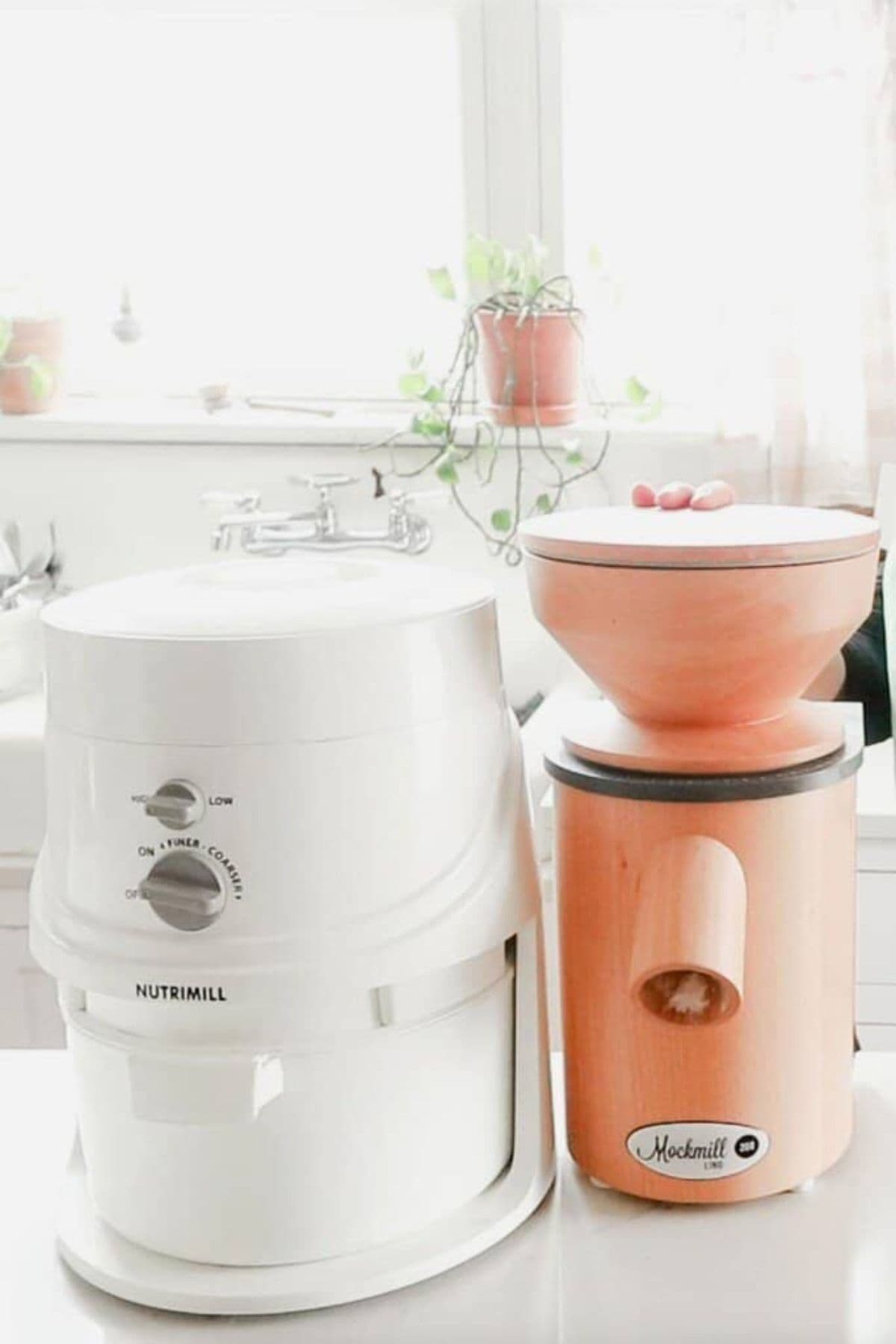
Do you want to pick the best grain mill and are overwhelmed with the choices? Come learn the differences between the Mockmill vs. the NutriMill for the best small flour mill for home use.
Ready to mill your own flour at home? If you are ready to make fresh milled sourdough bread, whole wheat pizza dough, and freshly milled cinnamon rolls, the first thing you’ll need is a grain mill.
Choosing the right grain mill can feel like a daunting task. I’ve put together the pros and cons of the more popular electric mills, the Mockmill and the NutriMill classic.
Once you choose your mill, make sure you check out my post on where to buy wheat berries.
Benefits Of Milling Your Own Flour
Nutrition Benefits – Store-bought flour has the wheat germ and bran removed, which takes out the beneficial nutrients. Fresh flour is packed full of vitamins, antioxidants, fiber, and is easier to digest.
Grains Last A Long Time – Grains in their whole form are very shelf stable. When stored properly, wheat berries can last up to 30+ years.
Preparedness – If you want to build a more sustainable and well prepared food supply, having a family grain mill and storing wheat berries is a great place to begin.
Best Grain Mill: Mockmill vs. NutriMill
The Mockmill
Pro’s of the Mockmill
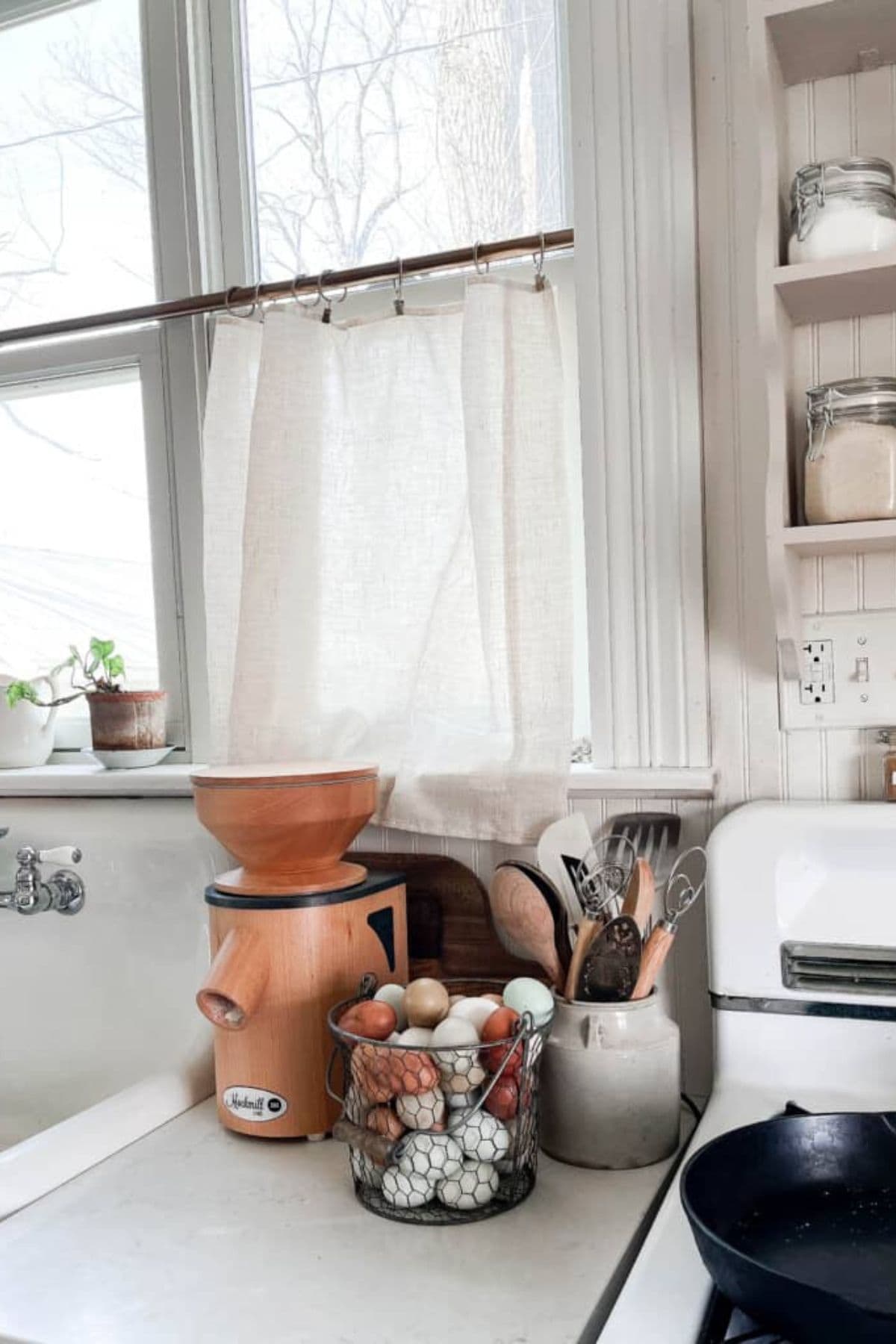
- Beautiful – This was the first reason I switched, which is a little vain. However, it really is beautiful and I can leave it out on the countertop, making it more convenient for everyday use.
- Smaller Profile – The slender profile of the Mockmill allows me to leave it out all the time without feeling pressed for countertop space.
- More Convenient – Since it doesn’t take up much space and has that small profile, I have no problem leaving it out on the counter all the time. This makes grinding flour so convenient, and I find myself using it so much more because of its ease of use.
- Stone Grinder – Stone mills grind grain between two stones which allows it to have more settings. You can make fine flour with the stones or use a coarser setting to crack grains or spices, so it has more versatility. The corundum-ceramic stone burrs are also self sharpening.
- Easier To Clean – To grind the flour, you just turn on the machine, add the grains, and it shoots the fresh milled flour right into a bowl. All you do is clean the bowl after use.
- Able to Re-mill Grains – Say you want to make homemade cornbread and you run the corn kernels through the grinder and find that the flour is a coarser flour than what you need. With the Mockmill, you can re-mill the grains at a finer setting, where you cannot re-mill coarse grains with the NutriMill classic.
Con’s of the Mockmill
- Smaller capacity – The hopper is smaller, so it holds a smaller amount of grain at a time compared to the NutriMill.
- Price Point – It is definitely pricier. If you are wanting the best electric grain mill and price is of concern, I would go with the Mockmill 100 in the white housing. It’s not as pretty as the birch wood, but it will get the job done. I find all the of benefits of the Mockmill worth the extra cost, as it is something I use consistently.
- Turn On The Grain Mill First – This isn’t a big deal, but you do have to turn the grain mill on before adding the grain. If you add the grain first and then turn it on, it will not work and you will have to take the whole thing apart and put it back together.
The NutriMill
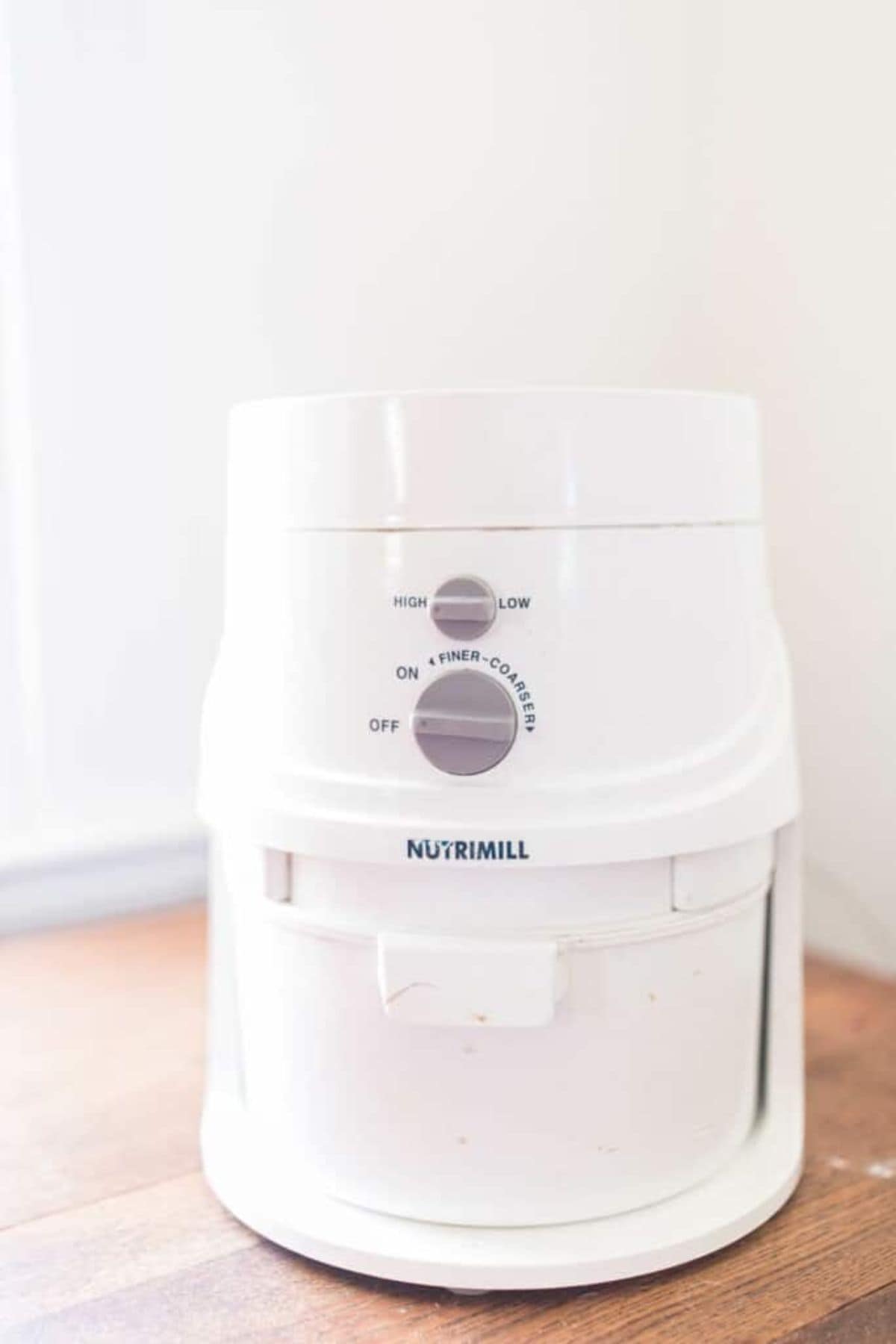
Pro’s of the NutriMill
- Large Capacity – I can easily fill the top portion up with grain and turn on the NutriMill, walk away, and come back with the large bowl filled with flour. Whereas the Mockmill has a small funnel that holds grain, so it can’t make quite as much at a time. But as long as you have a large bowl, you can still make a lot of flour.
- Price – You can find the Nutrimill classic for a more affordable price.
Con’s of the NutriMill
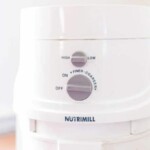
- Larger Profile – It is much bulkier in stature and takes up more space. Not only did I not want to leave it on the counter because of its looks and its size, but it also took up a lot of room in the cabinet.
- Not As Convenient – Since it isn’t as pretty, I kept it stored away in the bottom cabinet. Every time I wanted to grind flour, it had to be lugged out to grind. Even though this process isn’t super cumbersome, it did prevent me from grinding flour more often.
- Impact Mill – While this isn’t technically a con, it does limit its versatility. An impact mill essentially grinds the grain between two stainless steel fins that crack it into flour. The Nutrimill does heat up the grain more due to this type of grinder, but the studies have shown it heats it up less than 120 degrees, so it doesn’t impact the nutrients much.
- Harder To Clean – Since the Nutrimill has a bowl with a lid, you have to pull it out, detach it, then clean the separate parts. I didn’t wash it super often, but it is much harder to clean compared to the Mockmill.
- Produces More Dust Than The Mockmill – It tends to be more dusty compared to the Mockmill. Also if you do not make certain that the bowl is completely pushed in, you will have flour everywhere.
NutriMill Harvest
There have been newer NutriMill grain mills that have come out in more recent years. The NutriMill Harvest is a stone mill that has a look similar to the Mockmill, but is more budget friendly. While it may not be as efficient, it is a great option if you want an aesthetic and capable mill for baking.
FAQs
Yes. It can be significantly cheaper to mill your own flour, especially when buying in bulk. It is also less expensive depending on the type of flour. Being able to store whole grains for longer without them spoiling is also very cost effective.
There are many choices out there; I absolutely love and adore the Mockmill.
You can technically make flour if you have a high speed blender like a Vitamix. Check out my post on how to mill your own flour for more information on the ways you can mill flour.
The Mockmill 200 can mill grain twice as fast as the 100 model, and the 200 also has a slightly larger hopper capacity.
It can mill food-grade corn (not popcorn), wheat berries, rye, barley, oats, medium dried legumes, spelt, kamut, einkorn, brown rice, millet, quinoa, and some spices (must not be oily).






I am trying to decide which mockmil to purchase, 100 or 200. i know the 200 is faster but is it any stronger with regard to the harder grains or will the 100 handle it? i so enjoy your recipes and your fb page!!
The 100 can handle it!
Hello Lisa,
you mention Mockmill is not recommended for oily seed, what about sesame seed ? I mainly look to grind sesame seed to powder form ? Which device you recommend ? If it is not either of these two brands.
Have you tried the mock mill kitchen aid attachment grinder? Wonder if it works as well as the 100 version. Thanks!
I have not, but I have heard good things about it.
I appreciate this comparison!
Had you looked into the Nutrimill Harvest and decided against it for a specific reason? It seems as though it might marry the best of the “pros” there… plus yes, vanity dictates that I prefer the look. 😅🫣
Does your KitchenAid handle fresh milled grain dough well? Is there a reason you don’t use the KitchenAid grain mill attachment?
Is there a new offer and place i can buy the mockmill 200?
Love your videos
You can purchase the mockmill through any of the links in the article. They no longer have given me a discount, unfortunately.
Im new to milling my own grain for bread. Vitamix works fast and does good job but flour is very warm almost hot. Concerns me that some of the nutrients may be destroyed. What do you think?
It’s possible. That’s why I like to use the stone and not the steel options that the Mockmill has too…
Hello, thank you for this wonderful and informative video! Do you by any chance have a coupon code to use for Mockmill?
They took away coupon codes, unfortunately!
Have you by chance used the Nutrimill Harvest Grinder? I’m curious to compare that one to the Mockmill since it’s wooden and looks very similar! Those are the two I’m debating between.
Hi, Lisa! I really enjoy your blog, podcast and recipes! I received your sourdough book for Christmas. I recently purchased a Komo stone grain mill. I’ve previously been grinding grains in my blendtec blender. Even on the finest setting, my flour is coming out more coarse than it did with my blender. I’m considering sending it back and getting an impact mill. Do you notice any difference in the fineness of your flour with the Mockmill compared to your old nutrimill?
Yes! There is a big difference from the Nutrimill to the MockMill. My Mockmill is what I credit my success to for whole grains! It grinds the flour so finely.