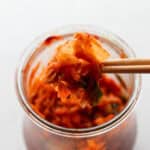
Fermented Homemade Kimchi
Learn how to make this homemade kimchi recipe that is not only super delicious, but also packed with gut healthy probiotics.
Servings: 16 servings
Equipment
- 1 Fermentation Lid optional
- 1 WECK jar 738 (59 oz) You can also use mason jars or other jars you have on hand!
Ingredients
- 2 heads of Napa cabbage or 4 heads of baby Napa cabbage, chopped
- 3 tablespoons sea salt
- 2 teaspoons brown sugar organic
- 2 teaspoons ginger grated
- 2 cloves garlic minced
- 8 green onions chopped
- 6 tablespoons Korean chile flakes
- 1 tablespoon fish sauce optional
- 4 carrots grated, optional
Instructions
- Reserve a few outside cabbage leaves to use for pushing the kimchi below the brine.
- Chop and grate all the vegetables on a cutting board and add them, with the rest of the ingredients, to a large bowl.
- Using clean hands, massage the ingredients together, so that the salt causes the cabbage to sweat and make a brine.
- Let it all sit for a few minutes. You want everything to get nice and juicy.
- Pack the mixture tightly into a large jar or or multiple smaller jars. I used a WECK jar 738 (59 oz).
- Fold up a cabbage leaf, that you saved earlier, and use it to keep all the veggies down below the salty brine. The cabbage and other ingredients should create enough brine to be able to submerge everything.
- Add weights to the top of the mixture and add a fermentation lid* (See notes for more information on a fermentation lid and what to do if you don't have one.)
- Place the jar in a baking dish in case of any liquid that may overflow, and let it sit out for up to five days. Starting on day 2, check your ferments every day. The warmth of your home will determine how long it takes to ferment. It could take anywhere from 2 to 5 days. The best way to determine if it is ready is by taste!
- Take the weight and folded up cabbage leaf out. Replace with the regular mason jar lids.
- Store in the refrigerator for later use, and enjoy this homemade traditional Korean recipe!
Notes
-
-
- *A fermentation lid is great to have if you plan to do a lot of fermenting. It allows carbon dioxide to escape, while, at the same time, keeps oxygen out of the jar. This helps prevent mold or other contamination.
-
- If not using a fermentation lid, you can use a regular lid. Just be sure to burp the kimchi once or twice a day and check that all the vegetables are still below the brine. You can do this by opening the jar briefly and then resealing it in order to allow the buildup up of gases inside to release.
-
- Sometimes, I like to top off my ferments with a little bit of water to make sure everything is good and submerged. When fermenting any vegetable, you want to make sure you use non-chlorinated water, as chlorine can kill the good bacteria.
-
- Cooler climates usually slow down fermentation, while warmer climates make it ferment faster. Keep this in mind when making your new batch of kimchi.
-
- Do not let your kimchi ferment in direct sunlight. The best way to let it ferment is to place it in a cool dark place at room temperature away from any windows.
- Seeing tiny bubbles form in your kimchi while it is fermenting is a positive indication that the fermentation process is going well.
- If using mason jars, it yields 3 pint jars, approximately 4 servings each.
-
Nutrition
Serving: 1g | Calories: 38kcal | Carbohydrates: 8g | Protein: 2g | Fat: 1g | Saturated Fat: 0.1g | Polyunsaturated Fat: 0.3g | Monounsaturated Fat: 0.1g | Sodium: 1467mg | Potassium: 398mg | Fiber: 3g | Sugar: 3g | Vitamin A: 3855IU | Vitamin C: 33mg | Calcium: 108mg | Iron: 1mg