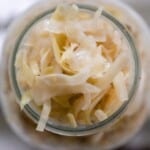
How To Make Sauerkraut
This homemade sauerkraut recipe is an easy and gut healthy way to get probiotics. The perfect side to a meal, this fermented raw sauerkraut will become a family staple.
Servings: 25 Servings
Equipment
- 1 Glass Fermentation Weights optional
Ingredients
- 3 heads cabbage about 5 pounds
- 2-3 tablespoons salt
Instructions
- With clean hands, pull off a few of the outer leaves of the cabbage and set aside for the last step.
- Next, core the cabbage and cut it into pieces small enough to fit in your food processor. If you do not have a food processor, just cut it into shreds or grate with a box grater. If you do have one, this part will go a little faster.
- Put the shredded cabbage in a large bowl and sprinkle the top of the shredded cabbage with the salt.
- For 5 pounds of cabbage, use 3 tablespoons of salt. I had 3.5 pounds, so I used 2 tablespoons.
- Work the salt in with your hands until it starts to get produce a juicy brine. You may have to work it for several minutes before you have enough brine to move onto the next step. You can also use a wooden spoon to do this.
- Next, put all the cabbage and the brine into a clean jar (you could use a fermentation crock, half gallon, or quart jars). Punch it down until all the cabbage is submerged beneath the brine.
- Fold up the cabbage leaves you reserved earlier and place on the top to keep all the cabbage down beneath the brine.
- Place fermentation weight on top of the folded cabbage and press it down until all of the cabbage is submerged in the brine. Place a lid on loosely or a add a fermenting lid.
- Leave it out on the counter at room temperature for 5 days-3 weeks, preferably out of direct sunlight. It will just become more pungent as it sits. If this is your first time trying homemade sauerkraut, it may be better to ferment it for less time.
- Remove the weight and folded up cabbage leaves, screw the lid on the jar and store in the fridge.
Video
Notes
- If not using a fermentation lid, be sure to burp the jar (open the lid every day while fermenting to release air bubbles) and to make sure the cabbage stays below the surface of the brine. If any cabbage is above the liquid it will be exposed to oxygen and possibly mold, so that is why it is so important to keep it under the liquid.
- You may want place the jars on a pan or baking dish just in case the brine spills over.
- When fermenting sauerkraut, the ideal temperature is a room around 65-70 degrees Fahrenheit.
- I love using glass fermentation weights, but if you don’t have any you can use clean rocks in a sealed ziplock bag, as long as the bag is able to be fully submerged beneath the brine.
- Those who are new to sauerkraut may want to try fermenting for 3 days at first before any longer fermentation period. Taste your sauerkraut after the initial 3 - 5 days and stop fermenting or continue on longer based on your taste preference.
- A food processor makes this process really simple, if you don’t have one you can just chop it as finely as possible.
- Not using enough salt may cause harmful bacteria to grow. The point of the salt is to keep the unwanted bacteria out and only allow the good bacteria to flourish. For every 5 pounds of cabbage, use 3 tablespoons of salt.
Nutrition
Serving: 1Serving | Calories: 27kcal | Carbohydrates: 6g | Protein: 1g | Fat: 0.1g | Saturated Fat: 0.04g | Polyunsaturated Fat: 0.02g | Monounsaturated Fat: 0.02g | Sodium: 578mg | Potassium: 185mg | Fiber: 3g | Sugar: 3g | Vitamin A: 107IU | Vitamin C: 40mg | Calcium: 44mg | Iron: 1mg